The World That Never Was
Imagine, for a moment, a world without flaw. A world where every line falls exactly where it is meant to, where every stroke lands with mathematical certainty, where nothing wavers, nothing surprises, nothing breaks from the plan. It sounds, at first, like an artist's dream. It is, in truth, an artist's grave.
In such a world, there would be no art — only manufacture. Art does not emerge from certainty; it emerges from the tension between what we intend and what actually arrives beneath our hand. The gap between the two — that trembling, unplanned space — is where a soul enters the work. A perfect world would have no need for meaning, because meaning is what we reach for precisely because things are incomplete, unresolved, imperfect. Art is the human answer to imperfection, not its opposite.
Where the Energy Actually Comes From
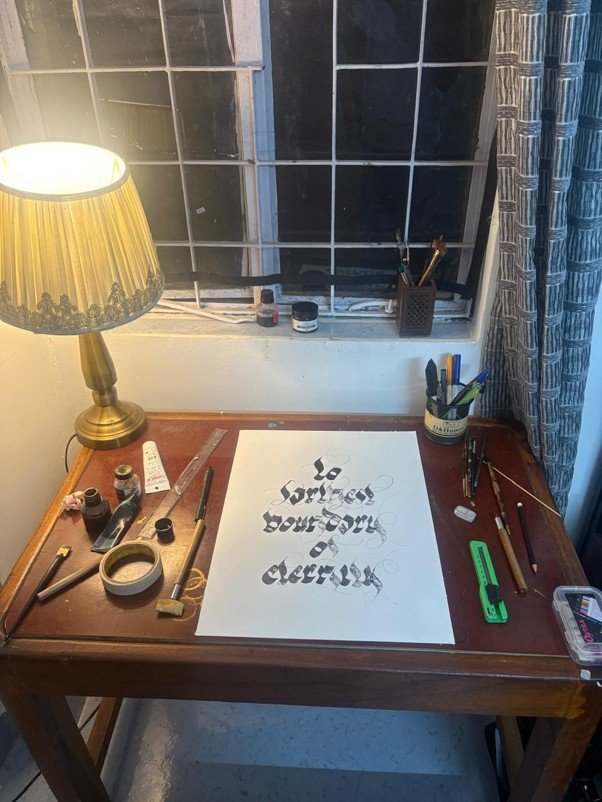
Every calligrapher who has stood before a blank page knows this feeling: the moment before the pen touches down, when an idea rises from somewhere deep and unnamed, before it takes final shape. That rising is not calculation. It is energy — raw, formless, alive — and it is born precisely because something in us is unresolved, searching, incomplete.
If we were already whole, already finished, already perfect, there would be nothing left to search for, and so nothing left to visualize. The very act of imagining a form that does not yet exist is proof that imperfection lives at the center of creation. The blank page is imperfect because it holds nothing. The idea that rises to fill it is a response to that absence. And the stroke that finally lands — wavering, human, alive — is the visible trace of that entire, imperfect, beautiful process.
This is why a mistake on the page is never truly a mistake. It is energy taking an unplanned form. It is the visualization arriving slightly differently than the mind expected, because the hand, the ink, and the moment itself all carry their own truth that no plan can fully contain.
What the Builders and Makers Knew
Ayn Rand, writing of the uncompromising architect Howard Roark in The Fountainhead, put forward an idea that still unsettles readers today — the line, "a man's ego is the fountainhead of human progress." Stripped of its provocation, there is something quietly true in it for every artist: progress, innovation, the next unmade thing, rises from the individual self daring to trust its own imperfect, unrepeated vision rather than copying the safety of what already exists. Every true innovation was once someone's flawed first attempt, defended long enough to become something new.
Leonardo da Vinci, centuries earlier, is widely remembered for a simpler and gentler observation — that art is never finished, only abandoned. Whether or not those exact words were his, the wisdom in them has outlived any single attribution, because every artist recognizes it instantly. There is no final, flawless version of a painting waiting to be reached. There is only the moment the maker decides: this imperfect thing, as it stands now, is enough to release into the world.
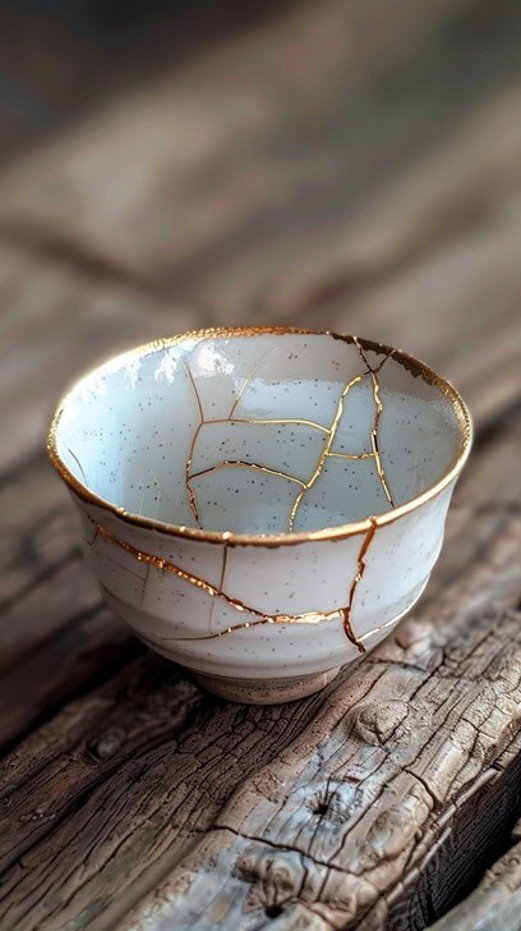
The old Japanese aesthetic of wabi-sabi understood this centuries ago, seeing beauty precisely in what is incomplete, weathered, and impermanent. And in the art of kintsugi, broken pottery is not discarded but repaired with seams of gold — the crack is not hidden, it is honored, made into the most luminous part of the object. The break does not diminish the bowl. The break is where the gold goes.